
Offset Handle Shears: How the Handle Changes Your Grip, Wrist and Shoulder
Hold a pair of scissors and point the tips at a mirror. Does your elbow drift up and out to the side? That small lift, repeated all day, is the problem offset handle shears were designed to reduce. They move the thumb ring back and down so the hand, wrist and elbow can stay lower while you cut.
Quick answer: offset handle shears have a shorter thumb handle than finger handle, so the thumb ring sits behind the finger ring instead of level with it. That lets you hold the shears with a flatter wrist and a lower elbow. Makers such as Jaguar Solingen say this relieves strain on the wrist, shoulder and neck. Choose one if you cut often, cut with your fingers facing the floor, or feel your shoulder after a session.
The evidence is real but thin. A 2003 study in the International Journal of Industrial Ergonomics tested an ergonomically shaped hairdressing scissor against standard scissors. The 44 stylists preferred the new design and reported less shoulder and wrist pain. They also bent the wrist less. However, that test used one patented design, not offset shears in general.
So the honest summary is this. The handle shape changes your posture, and posture matters for repetitive work. But no handle removes the risk on its own, and fit counts as much as shape.
This guide compares offset, classic and crane handles, gives you a quick fit check, and shows how to hold and use the shears well.
Recommended Offset Handle Shears for Home and Salon Cutting
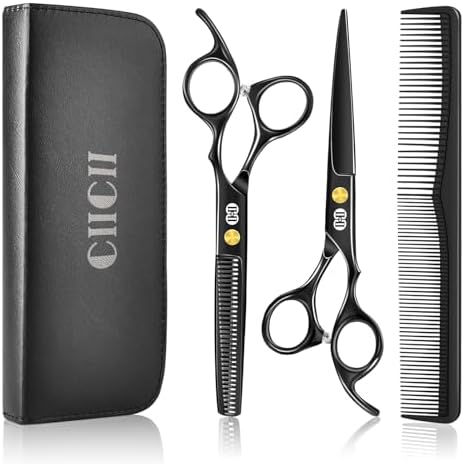
Each pick below is sold with an offset or semi-offset handle: cutting shears for everyday trims, a kit with a matching thinner, a German-brand offset design and one offset chunker. Check the length and finger-ring size against the fit check further down. See how we test and choose products for the rules behind every pick.


Key Takeaways
- Offset handle shears have a shorter thumb handle, which lets you cut with a flatter wrist and a lower elbow.
- Classic (opposing) handles are symmetrical, while crane handles drop the thumb side even further than a standard offset.
- Makers describe offset handles as relieving wrist, shoulder and neck strain, but independent studies of offset shears specifically are scarce.
- One 2003 study found stylists reported less shoulder and wrist pain and less wrist bending with an ergonomic scissor design.
- Fit matters as much as shape: ring size, length and tension decide whether a pair feels easy or tiring.
- Hold the shears with the thumb resting in the ring, not jammed through it, and let the elbow hang low.
- Keep the pair clean, dry and oiled, and have it sharpened by a specialist when it starts to fold hair.

What Makes Offset Handle Shears Different
Every pair of hair shears has two shanks, the arms that run from the pivot screw to the finger rings. On a classic pair, therefore, both shanks are the same length. The thumb ring and the finger ring sit side by side, like a mirror image.
Offset handle shears break that symmetry. The thumb shank is shorter, so the thumb ring sits back, closer to the pivot. Meanwhile, the finger shank is longer and often curves slightly. In addition, most offset pairs add a finger rest, or tang, below the ring finger.
Why does that help? Your thumb is shorter than your ring finger and sits lower on the hand. With a symmetrical pair, you have to lift and twist the hand so both digits reach rings that are level. That pushes the wrist into a bend and often raises the elbow. When the thumb ring moves back, the hand can stay closer to its natural shape. As a result, the wrist bends less and the elbow can drop.
Jaguar Solingen, the German scissor maker, defines the offset handle simply as an offset arrangement of the scissor eyes. It also says that this shape relieves strain on the wrist, shoulder and neck. Its scissors glossary also explains the classic and crane shapes, which we compare next.
Offset Handle Shears vs Classic and Crane Handles
Shopping sites often lump every “ergonomic” pair together. In fact, there are three main handle geometries, and each one puts your arm in a different place. The table separates them.
| Feature | Classic (opposing) | Offset | Crane |
|---|---|---|---|
| Handle layout | Symmetrical; both rings level | Thumb shank shorter; thumb ring set back | Thumb shank shorter and angled further down |
| How Jaguar describes it | A traditional cutting feel, often used for straight cuts | Relieves strain on the wrist, shoulder and neck | A significantly lowered thumb rest for a particularly relaxed hand position |
| Typical elbow position | Higher, because the hand turns to reach level rings | Lower, closer to the body | Often the lowest, since the thumb side drops furthest |
| Holding style it suits | Thumb with the middle or ring finger | A thumb and ring finger grip | The thumb and ring finger, with the little finger on a rest |
| Left or right use | Easy to flip between hands for some tasks | Made for one hand | Made for one hand |
| Who tends to pick it | Barbers and stylists who like a traditional feel | Most stylists who want a lower arm | Stylists with shoulder or wrist discomfort who want the most drop |
A fourth design, the swivel thumb, lets the thumb ring rotate as you cut. It can be combined with an offset or crane body. Our guide to rotating thumb designs covers that option in detail.
Some brands also sell “semi-offset” pairs. These sit between classic and full offset, with only a small difference in shank length. They suit people who want a gentler change from a classic feel.
What the Research Says About Shear Handles
Hairdressing involves thousands of small, repeated hand movements, often with the arms raised. As a result, strain is a well-known risk. So it makes sense to ask whether handle design helps.
The most direct test is a 2003 study in the International Journal of Industrial Ergonomics. Boyles and colleagues compared a patented ergonomic scissor design with standard hairdressing scissors in 44 volunteers. According to the study abstract, the stylists preferred the ergonomic design and reported less shoulder and wrist pain. They also reported significantly less wrist bending, and their grip strength was higher with the new design.
The authors also explain the mechanism. Standard scissors, they write, rarely let the hand sit in a neutral position, so the wrist stays bent. Repeated finger and forearm work with a bent wrist stresses the tendons that run through the carpal tunnel.
Occupational health trainers make a similar point. A 2021 training deck from the Occupational Health Clinics for Ontario Workers (OHCOW) lists what to look for in shears. It names light, balanced weight, neutral hand and wrist posture, ring configuration, the distance between the thumb and finger rings, and the angle of the handle. It also stresses that shears are “not a one size fits all” tool.
Fit Check: Are Offset Handle Shears Right for You?
Read the statements below and note which group describes you best. Then check the result underneath.
Group 1: you will likely feel a clear difference.
- You cut hair for several hours a day or several days a week.
- Your shoulder or upper arm aches after a long session.
- You cut a lot with your fingers pointing down, such as point cutting or vertical sections.
- With a classic pair, you notice your elbow lifting away from your body.
Group 2: an offset pair is a sensible default.
- You trim family hair or your own fringe now and then.
- Your natural grip uses the thumb and ring finger.
- One pair for most jobs is all you want, and you have no strong habit yet.
Group 3: a classic pair may still suit you.
- You cut mostly over a comb with the blades flat, like many barbers.
- Switching the shears between hands or flipping them for different angles is part of your routine.
- You learned on classic shears and feel no discomfort.
Result: mostly Group 1 means start with a full offset or a crane handle. If Group 2 fits best, a standard offset is a safe choice. For Group 3, stay with classic or try a semi-offset.
Handedness matters too. A left-handed person using right-handed shears has to squeeze the blades apart to cut, which adds strain whatever the handle. Our guide to shears for left-handed stylists explains the difference between a true left-handed pair and a flipped handle.
How to Hold Offset Handle Shears
A good handle only helps if you hold it the way it was designed. Most offset pairs assume a thumb and ring finger grip.
- Ring finger: slide it into the longer finger ring, up to about the first knuckle.
- Little finger: rest it on the finger tang, if the pair has one. This way it steadies the shears.
- Index and middle fingers: lay them along the shank toward the pivot for control.
- Thumb: place only the tip in the thumb ring. Pushing the whole thumb through makes the hand tense.
Now open and close the blades a few times. At first, only the thumb should move. The finger blade stays still, and the thumb blade does the work. Because of this, the cut stays steady and uses fewer muscles.
How to Cut with Offset Handle Shears, Step by Step
The method below applies to simple trims at home. It focuses on keeping the arm and wrist relaxed while you work.
- Set the height. Seat the person so their head sits around your chest level. Then you do not have to lift your arms high or bend forward.
- Check the tension. Hold the shears by the finger ring with the tips up and lift the thumb blade to 90 degrees. It should drop partway and stop. If it swings shut or stays up, adjust the screw a little.
- Take your grip. Ring finger in the finger ring, little finger on the tang and only the thumb tip in the thumb ring.
- Section the hair. Comb out a small, even section. Smaller sections also mean shorter, easier cuts.
- Move your body, not your wrist. Step around the chair to change the angle instead of twisting your hand. Keep the elbow low and close to your side.
- Cut with the thumb only. Close the blades with smooth thumb movement and keep the finger blade still.
- Pause and shake out. Every few sections, relax your hand, let your arm drop and check the result in the mirror.
If you also use toothed shears to remove bulk, the same grip applies. Our guide to softening bulk with thinning shears explains where to place those cuts.
Myths About Ergonomic Shears
Marketing around shear handles can be loud. Here are four claims worth questioning.
Myth 1: “Offset shears prevent injury.” However, no handle can promise that. The 2003 study measured reported pain and wrist bending over a short test, not injury rates over years. Posture, breaks, workload and fit all play a part.
Myth 2: “The bigger the offset, the better.” A deep crane handle suits some hands and feels awkward in others. As OHCOW puts it, shears are not one size fits all. The best shape is the one that keeps your own wrist neutral.
Myth 3: “Offset means better steel.” In reality, handle shape and blade quality are separate. A budget offset pair can have soft steel, and a premium classic pair can have an excellent edge.
Myth 4: “Only professionals need them.” Home users cut less often, so the benefit is smaller. Still, an offset pair costs nothing extra in effort to learn, and many home kits now use one.
What to Check Before Buying Offset Handle Shears
Handle shape is the headline, but several other specs decide comfort. So use this table as a checklist when you read a listing.
| Spec | What to look for | Why it matters |
|---|---|---|
| Handle type | “Offset”, “semi-offset” or “crane” stated clearly | Vague “ergonomic” wording can mean almost anything |
| Length | About 5.5 to 6 inches for most home trims | Shorter blades are easier to control near ears and the face |
| Finger rings | Removable inserts in several sizes | A snug ring means less squeezing to keep control |
| Finger tang | A rest for the little finger, fixed or removable | Supports the hand so fewer muscles work to hold the tool |
| Tension screw | Adjustable, ideally with a dial or click system | Blades that are too tight make the thumb work harder |
| Weight and balance | Light, with weight centred near the pivot | OHCOW lists light, balanced weight as a key shear feature |
| Handedness | Right- or left-handed blades to match your cutting hand | The wrong hand forces extra pressure on every cut |
Finally, remember that steel grades such as 440C describe an alloy family, not how well a pair was finished. Reviews that mention a smooth, quiet close and edges that stay sharp tell you more.
Posture Habits That Matter as Much as the Handle
A better handle is one piece of the picture. The way you stand and move shapes the load on your arms far more than any single tool.
- Raise or lower the chair before you start
- Keep your elbows low and near your sides
- Walk around the client instead of reaching
- Relax your grip between cuts
- Shake out your hands during longer sessions
- Stop and adjust tension when cutting feels heavy
- Hold your arms above shoulder height for long
- Bend your wrist sharply to reach an angle
- Force dull blades through thick hair
- Push your whole thumb through the ring
- Cut for hours without a short break
- Assume one pair will suit every hand
Besides, these habits cost nothing. Combined with a pair that fits, they give your wrist and shoulder the best chance of staying comfortable.
Caring for Offset Handle Shears
Dull or stiff shears make you squeeze harder, which undoes the benefit of a good handle. Therefore, a short routine that keeps them light is worth it.
- Wipe the blades with a soft, dry cloth after every use to remove hair and product.
- Open the shears and clean around the pivot, where hair collects.
- Add a drop of scissor oil at the pivot, open and close a few times, and wipe off the excess.
- Store them closed, in a case, away from a damp bathroom.
- Send them to a specialist sharpener when they start to fold or push hair.
Check the tension each week as well. Screws loosen with use, and then a loose pair folds hair instead of cutting it.
Honest Limits
The research base is small. We could find one controlled comparison of an ergonomic scissor design, and it tested a single patented model. Moreover, much of what is written about offset handles comes from scissor makers and sellers, who have a clear interest in the claim.
Handle shape also cannot fix a poor setup. If the chair is too low, you cut for hours without a break, or the blades are dull, the strain remains. Likewise, a pair that is the wrong size for your hand can feel worse than a well-fitted classic pair.
Finally, the product listings below describe their own handles. We checked that each is sold as offset or semi-offset, but the exact angle varies by brand and is rarely stated.
When to See a Professional
Switching shears is a comfort choice, not a treatment. Speak to a doctor or physiotherapist if you notice any of these:
- Numbness, tingling or pins and needles in your fingers, especially at night
- Pain in the wrist, elbow or shoulder that lasts after rest
- Weakness in your grip or dropping tools
- Pain that returns quickly each time you cut
For shear fitting, a specialist scissor supplier or an experienced stylist can help you try different handles and ring sizes. If you cut hair for work, an occupational health service can review your whole setup.
- Chunking shears: taking weight out of very thick hair, and why they are easy to overdo.
- Barber shears: longer blades for scissor-over-comb work on short cuts.
- Razor combs: how a razor comb softens and thins hair, and when to avoid it.
- Oiling hair shears: how often and exactly where the oil goes.
Frequently Asked Questions
What are offset handle shears?
They are hair shears with a shorter thumb handle than finger handle. The thumb ring sits back from the finger ring, which lets the wrist stay flatter and the elbow lower.
Are offset handle shears better than classic shears?
For many stylists they feel more comfortable, especially over long sessions. Classic shears still suit people who cut over a comb or switch hands often.
What is the difference between offset and crane handles?
Both shorten the thumb side. However, a crane handle also angles the thumb side down more, giving a lower thumb rest and a more relaxed hand for many users.
Do offset handle shears reduce wrist pain?
Makers say they relieve strain, and one 2003 study found less reported wrist and shoulder pain with an ergonomic design. Evidence on offset shears as a group is limited.
Can beginners use offset shears?
Yes. Many home kits now use an offset handle, and the thumb and ring finger grip is easy to learn.
What size should I choose?
Many home users choose about 5.5 to 6 inches. Shorter blades are easier to control around the face and ears.
Can left-handed people use offset handle shears?
Yes, if the pair is truly left-handed with reversed blades. A right-handed offset pair in the left hand will cut poorly.
How should I hold them?
Put your ring finger in the finger ring, rest your little finger on the tang and place only your thumb tip in the thumb ring.
Are semi-offset shears different?
Yes. They have a smaller difference in shank length, so they sit between classic and full offset in feel.
How often should offset handle shears be sharpened?
When they start to fold or push hair. That depends on use and care, so check the edge often and use a specialist sharpener.
The Bottom Line
Offset handle shears move the thumb ring back so your hand, wrist and elbow can stay in a more natural position. Makers link that shape to less strain, and a small study of an ergonomic scissor design supports the idea, though strong evidence on offset handles alone is missing.
So choose by fit as much as by label. Pick the handle that keeps your own wrist straight, set the chair height, keep the blades sharp and take breaks. That combination does more for your arms than any single tool.



5 Comments