
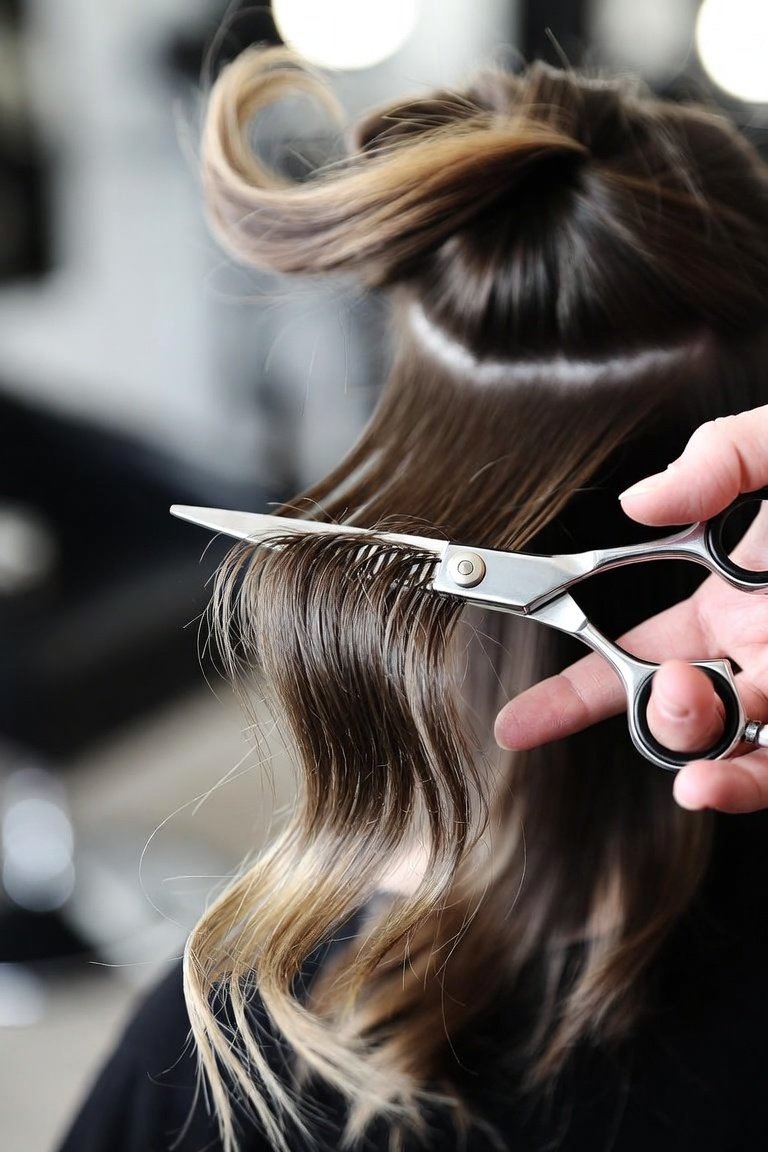
Chunking Shears: How to Remove Bulk From Thick Hair Without Leaving Holes
Picture this: you close a pair of chunking shears once near the crown, comb through, and a small gap stares back at you. That is the classic first-time mistake. These tools remove a lot of hair in a single close, so they reward careful placement and punish guesswork.
Quick answer: chunking shears are toothed scissors with a few wide, widely spaced teeth, so each close removes a large share of the hair in the section. They are meant for fast bulk removal in thick, dense hair, mostly in hidden areas such as the underneath layers. Use them sparingly, well away from the scalp and the hairline, and switch to a finer thinning or texturizing shear for anything visible.
The numbers explain the risk. Joewell, a Japanese scissor maker, lists its high-removal “cut and thinning” models at cut rates from 40 up to 80 percent. For comparison, its texture models sit at 10 to 30 percent. One close with a chunker can therefore do the work of several closes with a finer shear.
That speed is the whole point, and also the whole danger. Because the cut bundles are big, any cut that lands on the surface can show as a hole or a blunt line. Placed underneath, however, the same short pieces hide below longer hair and simply make the head feel lighter.
Below: what chunkers are, the naming overlap, a density test, a safe method, where to cut, how often, and how to choose.
Recommended Chunking Shears and Wide-Tooth Alternatives
Human-hair chunkers are scarce on Amazon, so this list pairs true chunkers, including a fishbone design and a set with a 7-tooth shear, with two wider-tooth texturizing shears as a gentler step down. Check the tooth count and stated removal on each listing. See how we test and choose products for the rules behind every pick.




Key Takeaways
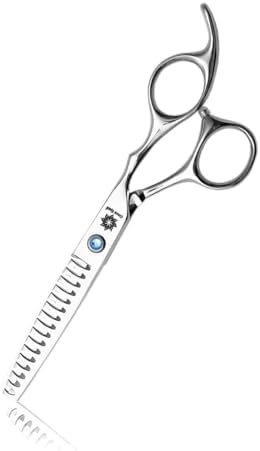
- Chunking shears have a few wide, widely spaced teeth, so each close removes a large share of the section.
- They suit thick, dense or coarse hair that needs fast bulk removal, not fine or thin hair.
- Names overlap: one brand’s 7-tooth “texturizing” shear removes more than another brand’s “chunker”.
- Pet grooming chunkers are a separate category, sold for coats rather than for human haircuts.
- Work underneath and inside the hair, never on the hairline, the parting or the top surface.
- Make one close per spot, comb out, and check the result dry before going further.
- Debulking lasts only until the cut pieces grow out, so light, spaced sessions beat one heavy one.
What Chunking Shears Are, in Plain Terms
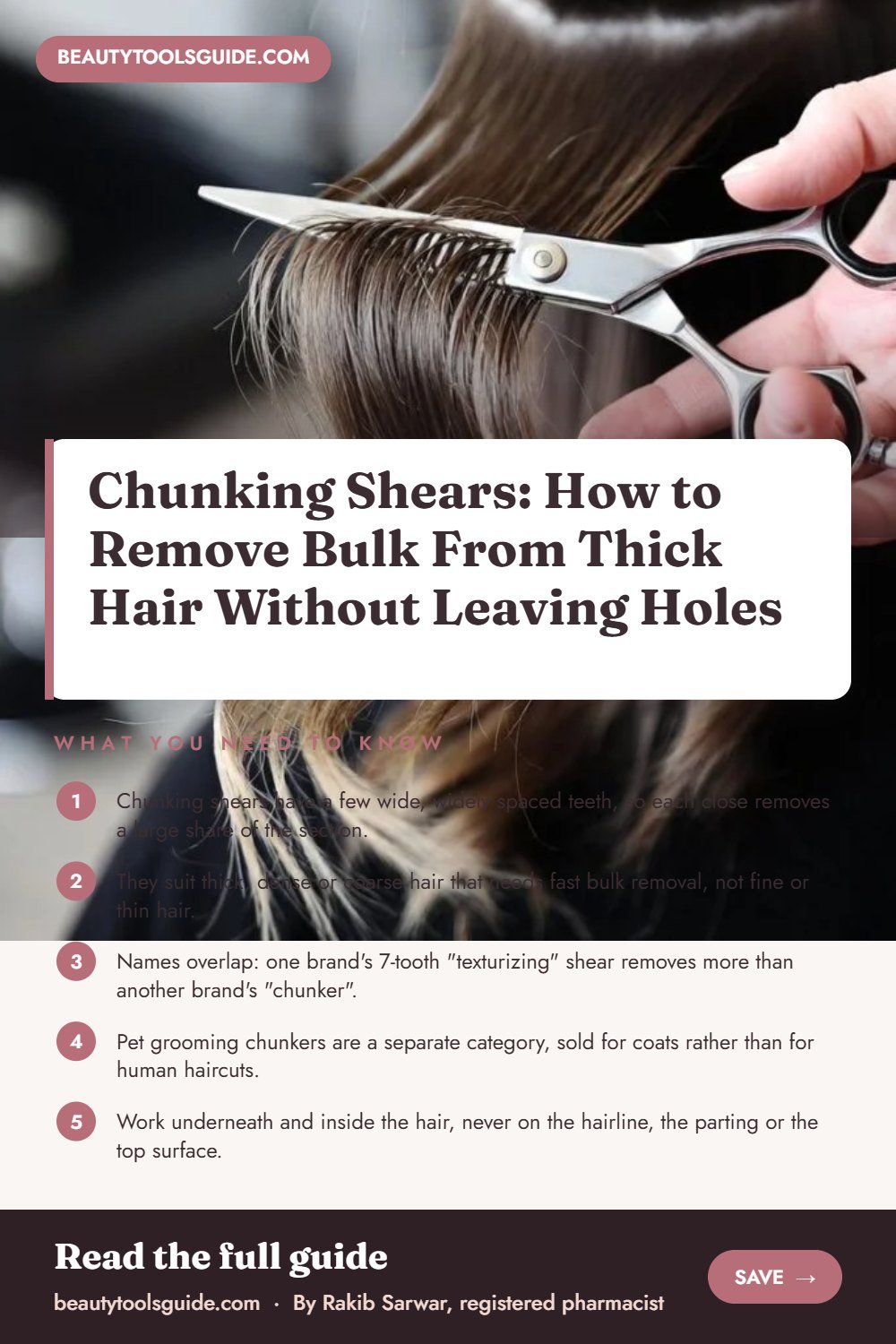
Every toothed shear works the same way. One blade is straight, and the other carries a row of teeth. Hair that sits against a tooth is cut, while hair in the gaps slides past untouched.
Chunking shears push that idea to the extreme. They have only a handful of teeth, and the teeth are wide with big gaps. So each close catches large bundles of hair, and a big share of the section ends up shorter. On a listing you will often see tooth counts in single digits or the teens.
That is why they are fast. A stylist can take weight out of a very dense head in a few closes instead of dozens. It is also why they need respect. The short pieces they leave are large, so they only disappear when longer hair covers them.
Chunker, Fishbone or Texturizer? Same Removal, Different Names
Shopping for chunking shears gets confusing fast, because brands use different names for tools that remove similar amounts. The table below uses figures stated by the makers or on the product listings themselves.
| Tool as sold | Teeth | Stated removal | Name used |
|---|---|---|---|
| ULG Shark Series fishbone shear | 16 | About 45 percent | Chunker |
| JW TS7 (part of a three-shear set) | 7 | About 75 percent | Texturizing |
| JW TS14 (same set) | 14 | About 50 percent | Thinning |
| Jaguar Solingen modelling shears | Not a single figure | About 40 to 50 percent | Texturizing |
| Joewell cut and thinning models | Not stated | About 40 to 80 percent | Cut and thinning |
The lesson is simple. A shear labelled “thinning” or “texturizing” can remove as much as, or more than, one labelled “chunker”. So judge any pair by its teeth and its stated removal, not by the word on the box. Joewell’s thinning range is a useful reference, because it groups models by cut rate rather than by name.
Hair Chunking Shears vs Pet Grooming Chunkers
Search for chunking shears and many results are made for dogs. The two share a name and a basic idea, but they are sold for different jobs.
| Feature | Hair chunking shears | Pet grooming chunkers |
|---|---|---|
| Main job | Removing bulk from dense human hair | Finishing and texturizing a coat, softening scissor marks |
| Typical length on listings | About 6 to 6.7 inches | Often about 7 inches or longer |
| Tooth style | Wide or fishbone teeth | Large T-shaped teeth, often a fishtail outline |
| Where they are used | Underneath layers and interior sections | Across the coat, including on curly and double coats |
| What to check | Tooth count, stated removal, handle fit | Whether the listing is meant for pets |
UK grooming supplier Groomers Limited describes grooming chunkers by their large T-shaped teeth and fishtail shape, and says they help finish a coat and soften heavy scissor marks. That is a different brief from debulking a human haircut, so read the listing before you buy.
Is Your Hair a Candidate? The Density Test
Chunkers only make sense on hair with plenty of density to hide the cut pieces. Try this quick test before you buy a pair.
- Part test: part your hair in the middle and look at the scalp. Hard to see (A) or easy to see (B)?
- Ponytail test: gather the hair into a ponytail. Does it feel thick and heavy in your hand (A) or slim (B)?
- Drying test: does air-drying take much longer than your friends’ hair (A), or is it quick (B)?
- Shape test: does your hair puff out into a triangle at the bottom (A), or does it lie flat (B)?
Mostly A: you have the density chunkers are made for. Still, start underneath and make fewer cuts than you think you need.
Mixed: a finer shear is the safer first step. Our guide to shears for movement and piecey texture covers the middle ground.
Mostly B: skip chunkers. They will likely make your hair look sparse.
Where Chunking Shears Belong on the Head
Placement matters even more with chunkers than with finer shears. Because the cut bundles are large, the rule is simple: cut where longer hair will cover the result.
- Nape and underneath layers: the safest zone. Here the weight sits, and the top layers hide the short pieces.
- Behind the ears: a common spot where dense hair pushes the shape outward.
- Interior of thick sections: lift the top section away and work inside, not on the outer surface.
- Hairline, parting and fringe: leave these alone. Short pieces here stick up and show immediately.
- Crown surface: also avoid it. Hair falls away from the crown, so gaps there are easy to spot.
Hair texture changes the picture too. Straight, coarse hair usually hides chunked pieces well, because the longer hair lies flat over them. Wavy hair can work, but check it dry, since waves lift short pieces toward the surface. Curly and coily hair is the hardest case. Short cut curls spring up and can form a halo or frizz, so many curl specialists prefer to remove bulk curl by curl instead of with a toothed shear.
Finally, think about how you wear your hair. If you often tie it up, the nape and the area behind the ears become visible. In that case, keep chunking cuts higher inside the interior, where a ponytail still covers them.
How to Use Chunking Shears Safely
The method below slows you down on purpose. With a high-removal tool, patience is the safety feature.
- Finish the haircut shape first. Cut length and layers with regular scissors, then debulk. Chunkers remove weight; they do not set the shape.
- Dry and detangle the hair. Dry hair shows its true density, so you can see where the weight really sits.
- Clip away the top layers. Work from the nape upward and keep the surface hair out of the way until the end.
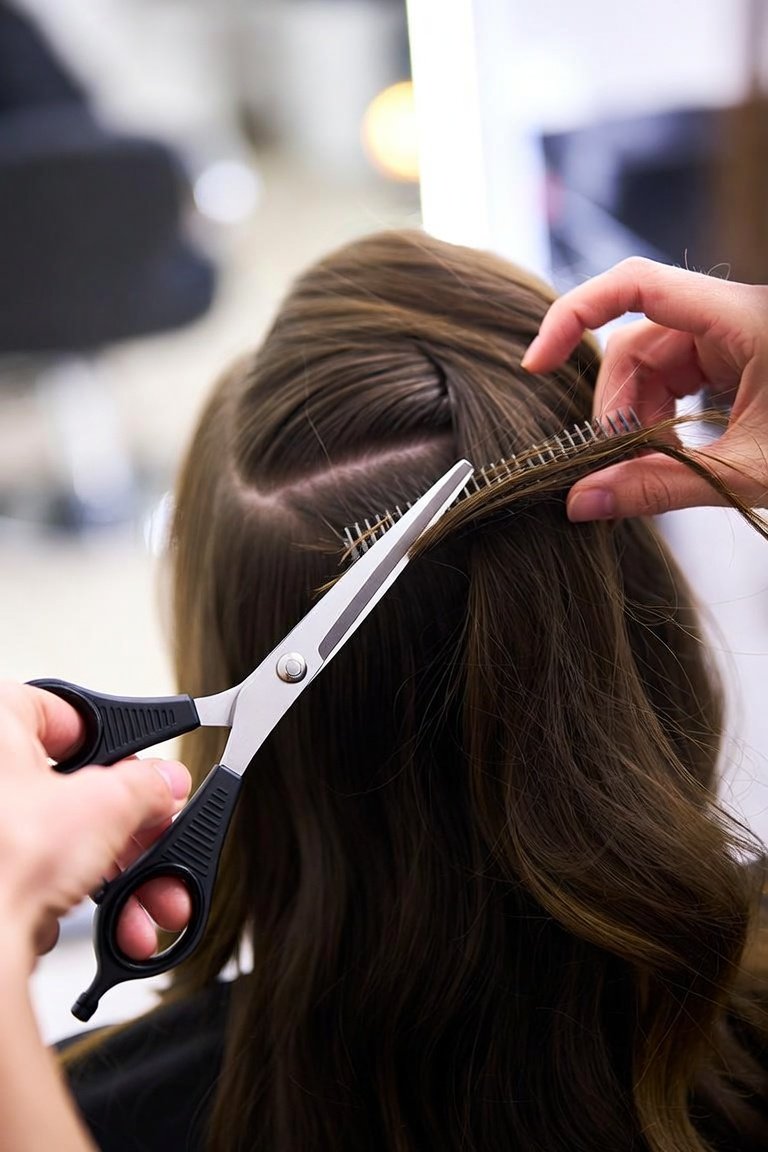
- Take a thin section and lift it. Hold about a finger’s width of hair out from the head so you can see the blades.
- Close once at mid-length or lower. Angle the shears slightly and make a single close, then move to a new spot.
- Space the next cut well apart. Leave plenty of untouched hair between cuts so no two land in the same place.
- Drop the hair and check. Let the top layers fall, run your fingers through, and look in a mirror before cutting more.
Safe Habits and Risky Habits
Retailer Scissor Mall warns that chunkers can leave blunt, noticeable lines when used carelessly, and says they are not the best choice for blending layers. These habits keep that from happening.
- Work underneath, then move up
- Make one close, then move on
- Leave wide gaps between cuts
- Check dry hair in a mirror often
- Keep the blades below mid-length
- Switch to a finer shear for blending
- Cut the hairline, fringe or parting
- Close twice in the same spot
- Use chunkers on fine or thin hair
- Judge the result on wet hair
- Chase every bump in one session
- Rely on them to soften a line
How Often to Debulk With Chunking Shears
Debulking is temporary. The short pieces grow back toward the length of the hair around them, and the weight gradually returns. So the question is not whether you will need to debulk again, but when.
A sensible rhythm is to debulk when the shape starts to puff out again, often around the time you would trim anyway. Light, spaced sessions work better than one heavy session. For example, a few careful cuts underneath at each trim keep dense hair manageable without ever creating a see-through patch.
Also, pay attention to regrowth from earlier sessions. If you still see short pieces sticking up, wait. Cutting the same zone again too soon stacks short hairs on top of short hairs.
How to Choose Chunking Shears
For home use, simple features matter more than luxury finishes. Look for these on the listing.
- Stated removal: a figure in the 40 to 50 percent range is already strong. Higher numbers suit only very dense hair and experienced hands.
- Tooth count and shape: fewer teeth mean bigger bundles. Fishbone or T-shaped teeth grip hair so cuts stay predictable.
- Length: around 6 to 6.7 inches is easier to control on your own head than a long grooming shear.
- Handle: an offset handle can feel more natural for long sessions; a classic handle suits either side.
- Tension screw: an adjustable screw keeps the blades cutting cleanly as they wear in.
If a chunker feels like too much tool for your hair, a finer shear does the same job more slowly and with less risk. Our guide to finer shears for gentle bulk removal explains how cut rate changes the result.
Myths Worth Dropping
“More removal is always faster and better.” Faster, yes. Better, only on the right hair and in the right zone. On medium hair, a finer shear usually gives a smoother finish.
“Chunking shears create a chunky style.” Not really. Used correctly, the cuts stay hidden underneath, and the visible result is simply a lighter, flatter shape.
“Any shear called a chunker removes the most.” The naming table above shows otherwise. Always check the stated removal and the tooth count.
Honest Limits
Chunking shears remove weight. They cannot fix a haircut with the wrong shape, and they will not stop dense hair from growing back to its full weight. On fine, thin or curly hair, they often cause more problems than they solve.
The removal figures in this guide come from manufacturers and listings, not from independent tests, and they are approximate. Customer ratings mostly reflect sharpness and value rather than how a pair behaves on your hair. Very few human-hair chunkers have large numbers of reviews, which is why the product list includes wider-tooth texturizing shears too.
When to See a Professional
Home debulking works for simple maintenance on dense hair. Book a stylist instead when:
- You have never used a high-removal shear before
- Your hair is curly or coily and very dense
- You already have a gap or puffy patch to correct
- The goal is a new layered shape, not just less weight
- You notice your hair thinning or shedding more than usual
For that last point, see a doctor or dermatologist. Unexplained thinning needs a medical check before any cutting.
- Swivel thumb shears: a rotating thumb ring for stylists with wrist or shoulder pain.
- Hairdressing scissors: picking a main cutting pair for home or salon use.
- Left-handed shears: why true left-handed blades cut more cleanly for left-handed users.
- Cutting a bob at home: sectioning and checking the line step by step.
Chunking Shears FAQ
What are chunking shears used for?
They remove bulk quickly from thick, dense hair. Each close cuts a large share of the section, mostly in hidden areas underneath.
How are chunking shears different from thinning shears?
Chunkers have fewer, wider teeth and remove much more hair per close. Thinning shears have finer teeth and take out less.
How many teeth do chunking shears have?
Usually few. Listings often show single digits or the teens, such as 7 or 16 teeth. Check the stated removal too.
Can I use chunking shears on fine hair?
It is not a good idea. Fine hair cannot hide the large cut pieces, so it tends to look sparse or gappy.
Are dog grooming chunkers the same as hair chunking shears?
They share a name, but grooming chunkers are sold for pet coats and are often longer. Choose a pair sold for human hair.
Where should I use chunking shears?
On the underneath layers, behind the ears and inside thick sections. Avoid the hairline, parting, fringe and crown surface.
Should I use chunking shears on wet or dry hair?
Dry hair is easier to judge. It shows the real density, so you can see how much weight you are removing.
Why did chunking leave a hole in my hair?
Usually because a cut landed on the surface, near the scalp, or in the same spot twice. Space cuts widely and work underneath.
Can chunking shears blend layers?
Not well. They remove big bundles, which can leave lines. Use a finer blending or thinning shear to soften layers.
How often should I use chunking shears?
When the shape starts to puff out again, often around trim time. Several light sessions work better than one heavy one.
Final Word
Chunking shears are a specialist tool for dense hair. They remove weight fast, which makes them useful underneath and risky anywhere visible. Judge a pair by its teeth and stated removal, because names vary so much.
Then keep the routine calm: shape first, work dry, cut underneath, close once, space the cuts and check the back. When in doubt, reach for a finer shear or book a stylist.



4 Comments