
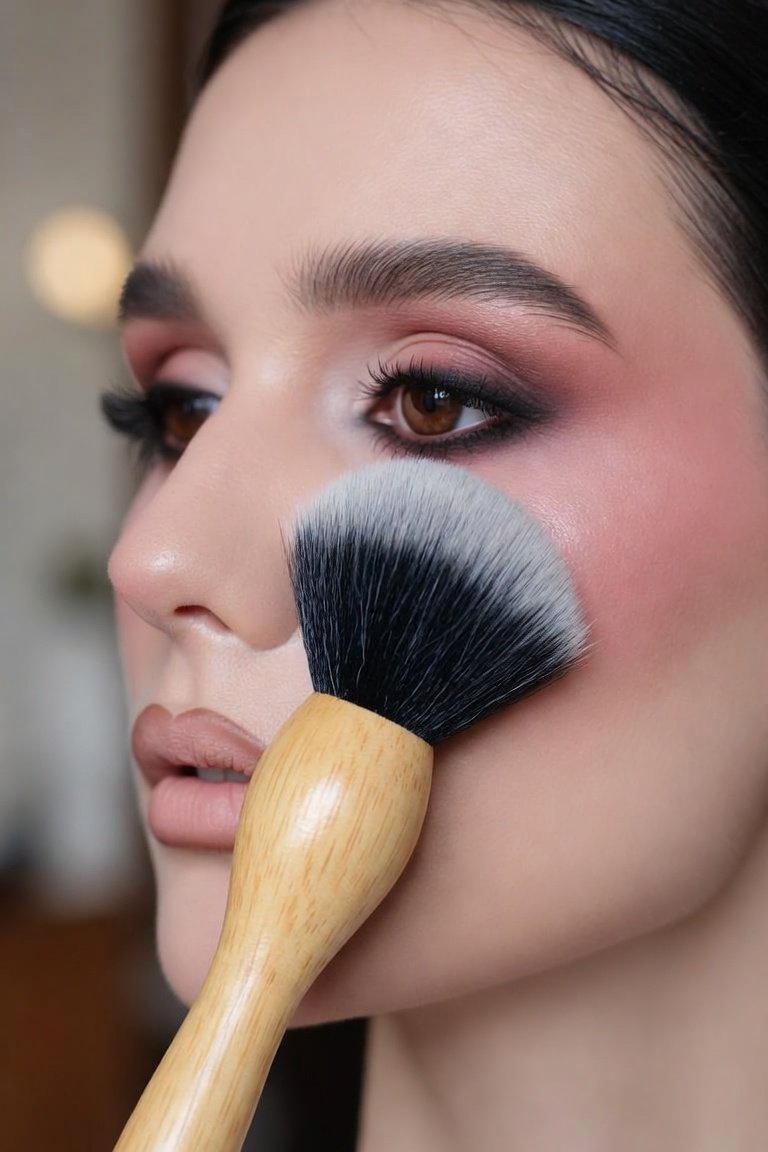
Round Kabuki Brush: What the Domed Head Does Best and How to Use It
A common belief says a round kabuki brush is only for loose powder. That sells the shape short. The short handle and dense, domed head make it one of the most flexible face brushes you can own, from mineral foundation to bronzer, and even cream or liquid when you work in thin layers.
Quick answer: a round kabuki is a short, dense brush with a rounded, dome-shaped top. The curve lets you buff product in circles without hard edges, which gives a soft, diffused finish. It is best known for powder and mineral foundation, bronzer and setting powder, but it can also blend cream and liquid formulas. Buff with light pressure, build coverage in thin layers, and wash it regularly.
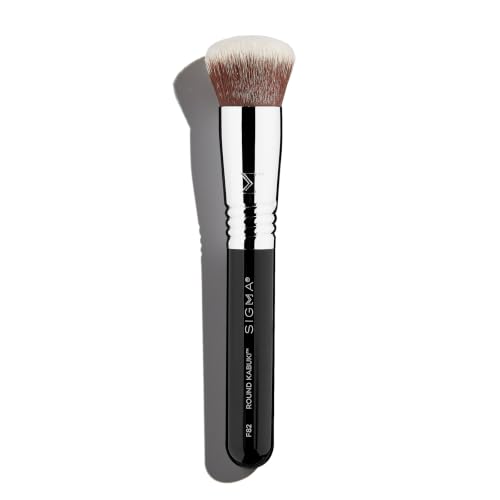
Manufacturer guidance supports that wider range. Sigma recommends buffing mineral powder with the domed head of its F82 Round Kabuki in circular motions. It also lists the brush for cream and liquid, with sheer to medium coverage from powder and medium to full from cream or liquid.
Care matters too. The American Academy of Dermatology suggests washing makeup brushes every 7 to 10 days, and a dense dome can hold a lot of powder, oil and skin cells. A 2025 study of 57 used cosmetic brushes found bacteria on them, though it found no clear link between cleaning habits and reported skin problems.
Below: a quick self-check, the round vs flat top difference, uses, technique, skin-type tips, sizes and cleaning.
Recommended Round Kabuki Brushes
Every pick is a round or domed kabuki: a pro favorite built for buffing powder, a small travel-size option, two dense domed foundation brushes, a round-top kabuki and a retractable round version for your bag. Match the head size to the job using the tips below. See how we test and choose products for the rules behind every pick.




Key Takeaways
- A round kabuki brush has short, dense bristles shaped into a dome, which blends product in circles with soft, diffused edges.
- Its strongest uses are powder and mineral foundation, bronzer, setting powder and blush.
- With cream or liquid, it can build medium to full coverage if you work in thin layers.
- A flat top kabuki presses product on for more coverage; the round version sweeps and buffs for a softer look.
- Light pressure and small circles matter more than the brand or the number of bristles.
- Wash it every 7 to 10 days, as the American Academy of Dermatology suggests, and dry it flat.
- Travel and retractable versions protect the bristles in a bag but have smaller heads.
What a Round Kabuki Brush Is Built to Do
Kabuki brushes are short and stout. A compact handle sits close to a tightly packed head, so the brush feels steady in the hand and does not flop. The round version shapes that head into a smooth dome. The center bristles are the longest, and the rest curve down toward the edges.
That curve changes how the brush meets the skin. Only part of the dome touches the face at once, and the contact point shifts as you move. So the brush lays down a little product, spreads it outward, and feathers the edges in one motion. On the other hand, a flat-cut head meets the skin all at once and deposits more product in one spot.
The dome also follows the contours of the face. It rolls over the cheekbones, the temples and the jaw without leaving a harsh line. That is why makeup artists often reach for a domed kabuki when they want coverage to fade out naturally, for example at the hairline or along the jaw.
Most round kabukis sold today use synthetic fibers. Sigma describes its F82 as having synthetic, antimicrobial fibers made to hold, apply and blend product. Some older or specialty brushes still use natural hair, which tends to pick up powder well but is harder to clean.
Self-Check: Is a Round Kabuki Brush Right for You?
Run through this short checklist. The more boxes you tick, the more use you will get from the shape.
- You wear powder or mineral foundation most days.
- Your goal is a soft, skin-like finish rather than full, matte coverage.
- Bronzer or blush often looks patchy or stamped on when you apply it.
- Setting powder tends to look heavy under your eyes or around your nose.
- A single brush that works for several products would simplify your routine.
- You want something compact that fits in a makeup bag.
Four or more ticks: a round kabuki will likely become a daily brush for you.
Two or three: it will be useful, but you may still want a flat top for liquid days.
One or none: a flat top kabuki or a sponge may suit your routine better.
Round Kabuki Brush vs Flat Top Kabuki: The Real Difference
These two brushes are often sold side by side and described in almost the same words. They are both short and dense, and both are called kabukis. Still, the shape of the top changes how each one works.
| Feature | Round (domed) kabuki | Flat top kabuki |
|---|---|---|
| Top of the head | Curved like a dome, longest in the center | Cut straight across, all bristles the same length |
| Contact with skin | A small, moving contact point | The whole flat face at once |
| Main motion | Swirl and buff in circles | Press or stipple, then buff |
| Typical finish | Soft and diffused, edges fade out | More even, higher coverage per pass |
| Strongest formulas | Powder, mineral foundation, bronzer, setting powder | Liquid and cream foundation |
| Around the nose and eyes | Curve reaches soft contours well | Flat edge can struggle in tight corners |
| Risk if overused | Too much powder on dry patches | Heavy, cakey foundation |
Neither shape is better overall. If your base is liquid, the flat top usually gives faster coverage. If you work mostly with powder or want the softest edges, the dome is the easier tool. For the pressed-on style, see our guide to flat-cut kabukis for liquid foundation.
Six Jobs a Round Kabuki Brush Does Well
A domed kabuki can replace several brushes in a small kit. Here is where the shape earns its place.
- Powder foundation: buffing in circles works pressed powder into the skin and avoids a dusty layer on top.
- Loose mineral makeup: the dense head holds loose powder well, so less of it falls onto your clothes.
- Bronzer: the curve lets you sweep color along the cheekbones and temples with soft edges.
- Setting powder: a light swirl sets makeup across large areas; for under the eyes, a smaller brush is more precise.
- Blush: a small round kabuki gives a diffused flush instead of a stripe.
- Body shimmer or self-tan: larger domed kabukis blend over shoulders, arms and legs.
If you want a fluffier tool just for setting, our guide to brushes for setting powder compares lighter options.
How to Use a Round Kabuki Brush With Powder Foundation
Powder is where the dome shines. These steps give an even, natural finish while keeping the powder layer thin.
- Start with prepared skin. Apply moisturizer and sunscreen and let them sink in. Powder clings to damp or greasy patches, so give your skin time.
- Load a small amount. Swirl the brush lightly in the powder. For loose powder, tap some into the lid first rather than dipping into the jar.
- Tap off the excess. Knock the handle gently on the edge of the container. Too much powder at once is the main cause of a cakey look.
- Buff from the center outward. Begin on the cheeks and use small circles with light pressure. Work outward toward the ears, forehead and jaw.
- Build in thin layers. Add a second layer only where you want more coverage. Several thin passes look more natural than one heavy one.
- Blend the edges. Sweep lightly along the jaw and hairline with an almost empty brush. This removes any line between the face and neck.
Using a Round Kabuki Brush With Liquid and Cream
The dome is not only for powder. Sigma lists its round kabuki for cream and liquid too, with medium to full coverage from those formulas. However, the technique needs a small change.
First, place a few dots of foundation on the face, not on the brush. Then buff them out with small circles and very light pressure. The rounded head spreads product thin, so you may need a second layer where you want more coverage.
Wet formulas soak into the dense head more than powder does. As a result, a brush used for liquid needs washing more often. Many people keep one round kabuki for powder and a second one, or a flat top, for liquid. That also stops leftover liquid from making powder patchy.
Round Kabuki Technique by Skin Type
The same brush can give very different results on oily, dry or mature skin. This table adjusts the method for each.
| Skin type | What to watch for | How to adjust |
|---|---|---|
| Oily | Shine breaking through by midday | Buff a thin layer of powder on the T-zone; press rather than sweep there |
| Dry | Powder clinging to flakes | Moisturize well first, use very little powder, and consider cream products |
| Combination | Different needs in different zones | More product on the T-zone, a light dusting on the cheeks |
| Mature or textured | Powder settling in lines | Use the lightest pressure, tiny amounts, and blend with an empty brush |
| Sensitive | Redness from rubbing | Slow, gentle circles; wash the brush often and avoid scrubbing |
Whatever your skin type, start with less product than you think you need. You can always add more, but removing powder from the skin usually means starting over.
Full-Size, Travel and Retractable Versions
Round kabukis come in several formats. Each suits a different routine.
Full-size face brushes have a longer handle and a larger dome. They cover the face quickly and feel comfortable for buffing a full base.
Travel or mini kabukis have a very short handle and a smaller head. They fit into a small bag and give more control for blush or contour, but a full face takes longer.
Retractable kabukis slide the bristles into a metal tube with a cap. That keeps powder off the rest of your bag and protects the dome from getting crushed. On the downside, a closed tube traps moisture, so make sure the brush is completely dry before you retract it.
For a fluffier, larger alternative for all-over powder, see our powder brush guide.
Cleaning Your Round Kabuki Brush
A dense dome traps powder, oil and skin cells deep in the head. The American Academy of Dermatology recommends washing makeup brushes every 7 to 10 days. It advises rinsing only the tips in lukewarm water, washing them with gentle or clarifying shampoo, rinsing until the water runs clear, and drying brushes flat with the tips over the edge of a counter.
The evidence on dirty brushes is mixed. A 2025 study of cosmetic brushes in Jeddah found a mix of bacteria on the 57 used brushes it analyzed, most often Micrococcus and Staphylococcus. In its survey, many people rarely cleaned their brushes. However, the authors found no direct link between cleaning frequency and reported skin problems. So regular cleaning is sensible hygiene, but it is not a guaranteed cure for breakouts.
- Rinse the tips under lukewarm water
- Work in gentle shampoo with your palm
- Press out water with a clean towel
- Dry it flat with the head over an edge
- Reshape the dome while it is damp
- Let a retractable brush dry fully first
- Submerge the ferrule and handle
- Stand it upright in a cup to dry
- Retract it while still damp
- Rub it hard against a textured mat
- Share it with other people
- Keep using it if it smells musty
Replace a round kabuki when the dome loses its shape, the bristles keep shedding, or it stays musty after a proper wash.
Honest Limits
A domed head cannot do detail work. It is too large and soft for concealing small spots, lining the inner corner of the eye or sharp contour lines. For those jobs, use a small concealer or detail brush.
For full, matte coverage with liquid foundation, a flat top kabuki or a damp sponge is usually quicker. On very dry skin, even gentle buffing with powder can highlight flakes.
Product listings also tell you less than they seem to. Terms like “dense”, “ultra soft” and “premium” are not measured the same way by every brand. Head size and dome shape vary widely, so a brush may be larger or firmer than the photo suggests.
When to See a Professional
Most people pick up the buffing motion quickly. Consider expert help when:
- You want a lesson on technique, which a makeup artist can show in minutes.
- An important event or photoshoot needs makeup that lasts and photographs well.
- Breakouts keep appearing even though your brushes are clean.
- Redness, itching or a rash follows a new brush or powder, which may signal irritation or an allergy.
A dermatologist is the right person for ongoing skin problems. A brush can change how makeup looks, but it cannot treat the skin underneath.
- Blush brushes: angled and round shapes for soft, natural colour.
- Stippling brushes: a two-layer brush for a light, airbrushed finish.
- Foundation brushes: flat, kabuki and buffing shapes for liquid foundation.
- Natural vs synthetic brushes: the real differences in use.
Round Kabuki Brush FAQ
What is a round kabuki brush used for?
Mainly for buffing powder and mineral foundation, bronzer, blush and setting powder. It can also blend cream and liquid in thin layers.
Is a round kabuki brush good for liquid foundation?
It can be. Dot the foundation on your face and buff with light circles. A flat top kabuki usually gives more coverage faster.
What is the difference between round and flat top kabuki?
The round kabuki has a domed head that buffs for a soft finish. The flat top is cut straight across and presses on more coverage.
Can I use one brush for foundation and bronzer?
Yes, but wipe or wash it between products, or keep two brushes, so colors do not mix.
How do I stop a round kabuki brush from looking cakey?
Load less product, tap off the excess and buff with light pressure. Build coverage in thin layers.
How often should I wash it?
The American Academy of Dermatology suggests every 7 to 10 days. Wash it more often if you use it with liquid.
Are natural or synthetic bristles better?
Synthetic bristles are easier to clean and suit liquid and cream. Natural hair picks up powder well but needs gentler care.
Is a retractable kabuki brush worth it?
For travel, yes. It keeps powder contained and protects the dome, but always let it dry fully before closing it.
Why is my round kabuki brush shedding?
Water may have loosened the glue, often from drying it upright. Dry it flat, and replace it if shedding continues.
When should I replace it?
When the dome loses its shape, it sheds regularly or it still smells after washing.
The Bottom Line
The domed head is designed to buff and diffuse. It is at its best with powder, mineral foundation, bronzer and blush, and it can blend cream and liquid in thin layers. Light pressure, small circles and small amounts of product give the softest finish.
Pair it with a flat top kabuki if you wear liquid foundation often, and pick a travel or retractable version for your bag. Wash it every week or so, dry it flat, and replace it once the dome loses its shape.




5 Comments