
Reusable Cotton Rounds: Materials, Real Eco Trade-Offs, Washing and How Many You Need
A popular myth says that any switch to reusable cotton rounds is automatically a win for the planet. The real picture is more interesting. A washable pad only beats a pile of disposable ones if you use it many times and wash it sensibly, because laundry has its own footprint.
Quick answer: reusable cotton rounds are small washable pads, usually cotton, bamboo-derived rayon or velour, that replace single-use cotton pads for removing makeup and applying toner. They cut the stream of pads going into the bin, and they can save money over time. Their environmental benefit depends on how you wash them: full loads, moderate temperatures and air drying keep the gain; hot, half-empty loads and tumble drying eat into it. Use them gently, give each face its own clean pad, and replace worn ones.
The strongest evidence on this kind of swap comes from a close cousin: diapers. A UK Environment Agency life-cycle study found that reusable nappies could have a higher or lower climate impact than disposables, depending on how they were laundered. Tumble drying everything raised the reusable footprint sharply, while full loads and line drying lowered it.
The same logic applies to face pads, just on a smaller scale. That makes your washing habits the main lever you control.
Below: what the pads are made of, an honest eco comparison, a quick fit-finder, a removal routine, washing and drying, how many you need, and when to replace them.
Recommended Reusable Cotton Rounds and Makeup Remover Pads
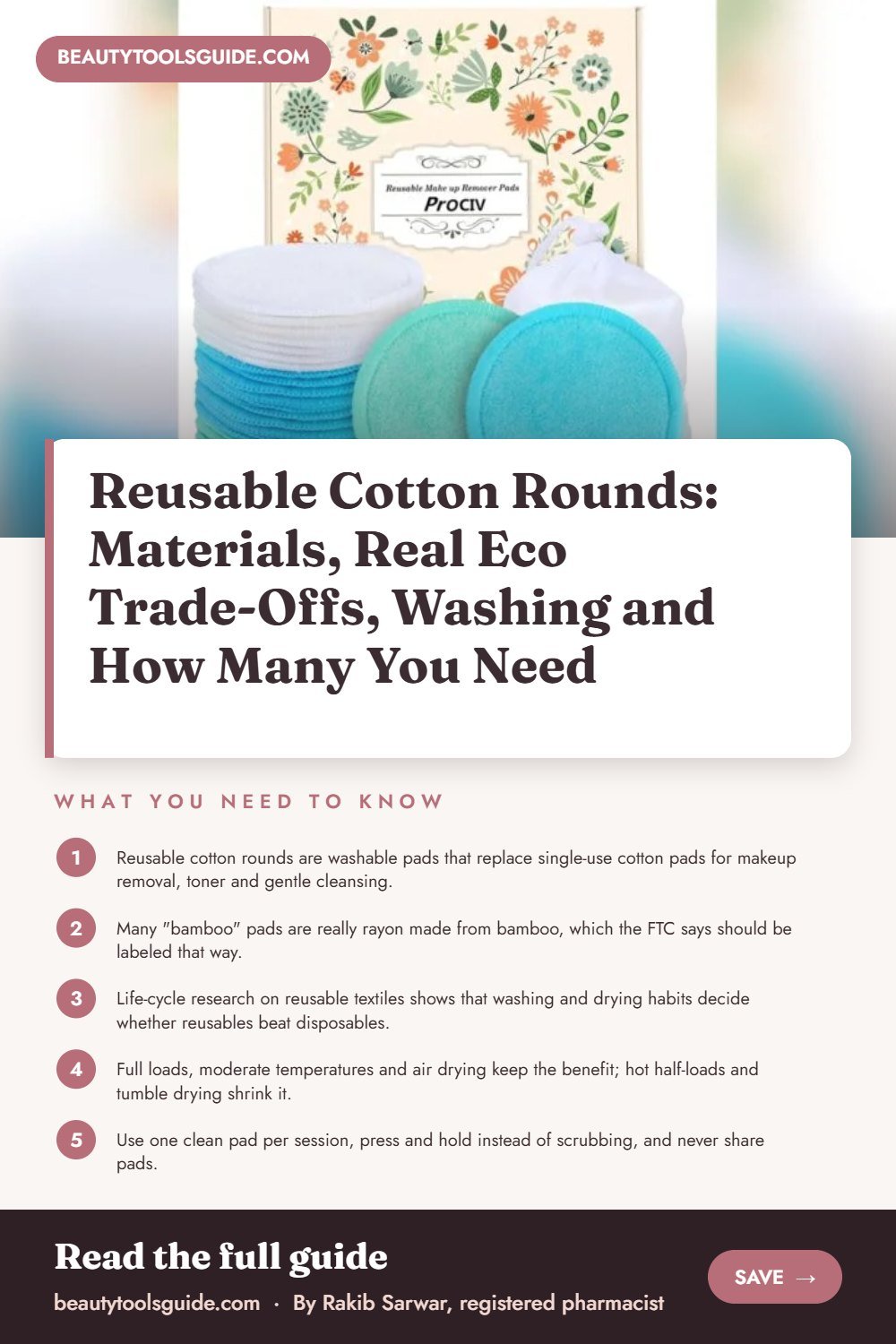
Each pick here is a washable makeup remover pad: soft cotton and bamboo-blend rounds, velour pads, a charcoal-colored set, a mixed pack that adds textured terry pads, and a compact seven-pad set. Check the fabric and whether a laundry bag is included on each listing. See how we test and choose products for the rules behind every pick.


Key Takeaways
- Reusable cotton rounds are washable pads that replace single-use cotton pads for makeup removal, toner and gentle cleansing.
- Many “bamboo” pads are really rayon made from bamboo, which the FTC says should be labeled that way.
- Life-cycle research on reusable textiles shows that washing and drying habits decide whether reusables beat disposables.
- Full loads, moderate temperatures and air drying keep the benefit; hot half-loads and tumble drying shrink it.
- Use one clean pad per session, press and hold instead of scrubbing, and never share pads.
- Most people need roughly two weeks of pads so they can wash them with a normal laundry load.
- Replace pads that stay stained, smell after washing, pill heavily or feel rough.
What Reusable Cotton Rounds Are Made Of
The name suggests plain cotton, but the fabric varies a lot from pack to pack. Most pads have two layers sewn together with an overlocked edge. One side is often smooth for toner or sensitive areas, while the other is looped or plush to grip makeup. The fabric decides how the pad feels, how fast it dries and how it survives the washing machine.
| Fabric | How it feels | Strengths | Trade-offs |
|---|---|---|---|
| Cotton flannel or knit | Soft and flat | Easy to wash, gentle on eyes, familiar feel | Stains show; can thin out over time |
| Cotton terry | Looped and textured | Grips waterproof mascara and heavy makeup | Loops can feel rough on sensitive skin |
| Rayon from bamboo blends | Very soft and silky | Absorbent, smooth on skin | Heavy chemical processing; often mislabeled as “bamboo” |
| Velour | Plush and velvety | Holds micellar water well, looks tidy | Often contains synthetic fibers that shed in the wash |
| Microfiber | Fine and grippy | Removes makeup with water alone for some users | Plastic-based fibers; can drag on dry skin |
The bamboo label deserves a closer look. According to the US Federal Trade Commission, most bamboo textiles are actually rayon. Makers dissolve the plant with chemicals and then spin new fibers, so no trace of the original plant remains. The FTC says such products should be labeled “rayon made from bamboo”. As a result, a “bamboo cotton” pad is usually a rayon and cotton blend. That does not make it a bad pad. However, it does mean the natural bamboo halo is mostly marketing.
Are Reusable Cotton Rounds Really Better for the Environment?
This is where most guides stop at “less waste”. Waste matters, yet it is only one part of a product’s footprint. A proper life-cycle assessment counts everything: growing the fiber, making the product, shipping it, every wash and dry, and finally disposal.
We did not find a published, independent life-cycle study of makeup remover pads alone. The closest well-documented comparison is the UK Environment Agency’s updated life-cycle study of disposable and reusable nappies. Like face pads, reusable nappies are cotton-based textiles that replace a single-use product and get washed at home. The study found that the climate impact of reusables could be higher or lower than disposables, depending on laundry habits.
For example, washing at 90 degrees C instead of 60 raised the reusable footprint by about 31 percent. Tumble drying every load raised it by about 43 percent. On the other hand, fuller loads and outdoor line drying each cut it by about 16 percent. In short, the product itself matters less than the way you care for it.
Disposable Pads vs Reusable Cotton Rounds at a Glance
| Factor | Disposable cotton pads | Reusable cotton rounds |
|---|---|---|
| Solid waste | One or more pads in the bin every day | A small set every year or two |
| Raw material | New cotton fiber for every pad used | Fiber made once, then used many times |
| Water and energy at home | None after purchase | Share of every wash and dry cycle |
| Biggest lever you control | Using fewer pads per session | Full loads, moderate heat and air drying |
| Hidden downside | Packaging and constant repurchase | Synthetic blends can shed fibers in the wash |
Face pads are small, so they add very little to a load you are already running. That is the key point. If they ride along with towels or clothes, the extra water and energy is modest. Instead, if you run a separate hot wash just for a handful of pads, you lose much of the gain.
Which Reusable Cotton Rounds Fit Your Routine?
Use this quick finder before you buy. Pick the line that sounds most like you, then look for that fabric and pack size.
You mostly remove light makeup or apply toner.
- Choose smooth cotton or a soft rayon blend. A pack of about 15 to 20 is plenty.
You wear waterproof mascara or long-wear foundation.
- Choose a pack with a textured terry or velour side, and pair it with an oil-based remover.
Your skin is sensitive, dry or easily red.
- Choose the smoothest, plainest cotton pads, and skip terry loops and microfiber.
You want the lowest shedding in the wash.
- Choose pads made mostly of natural fibers such as cotton, and wash them in a mesh bag.
You travel or share a small bathroom.
- Choose a small set with a case or bag, plus a spare bag for used pads.
How to Use Reusable Cotton Rounds Step by Step
The routine is simple, but technique changes how gentle it feels. The American Academy of Dermatology warns that scrubbing irritates skin, so the aim is to let the remover do the work.
- Wash your hands. Clean hands keep dirt and bacteria off the fresh pad and away from your eyes.
- Dampen the pad. Wet it lightly with water, then squeeze out the excess so the remover does not get diluted.
- Add your remover. Apply micellar water, a cleansing oil or a liquid remover until the pad is moist but not dripping.
- Press and hold on the eyes. Rest the pad on closed lids for about ten seconds, so mascara softens before you move it.
- Wipe gently in one direction. Sweep down and outward with light pressure, then fold or flip the pad to a clean side.
- Finish the face. Use the remaining clean area on the rest of the face, or take a second pad if the first is saturated.
- Cleanse and moisturize. Follow with your usual gentle cleanser, then apply moisturizer to calm any friction.
- Rinse and store the pad. Rinse it, squeeze it out and drop it into an open mesh bag to dry until laundry day.
Reusable Cotton Rounds by Skin Type and Makeup Type
The same pad can feel lovely on one face and scratchy on another. So match the fabric and pressure to your skin rather than the marketing.
- Sensitive or reactive skin: choose flat cotton, use a soothing remover, and keep pressure feather-light. Stop if you see redness after each use.
- Dry skin: pair pads with a cleansing oil or balm, because dry friction is harder on a weak skin barrier. Moisturize straight after.
- Oily or acne-prone skin: use a fresh pad every night, since a damp, reused pad can hold oil and bacteria. Wash pads often.
- Waterproof eye makeup: let an oil-based remover sit for a few seconds first. Then textured pads lift product without rubbing.
- Toner and essence: a smooth pad soaks up less product than terry, so you use less liquid per swipe.
If you prefer a single larger cloth for cleansing, our guides to microfiber makeup remover cloths and muslin cleansing cloths explain how those compare.
How to Wash Reusable Cotton Rounds Without Wasting the Benefit
Washing is the heart of both hygiene and the eco case. The goal is clean pads with the least extra energy, and luckily those two aims mostly line up.
- Rinse after each use. A quick rinse with a little soap removes most makeup, so stains do not set.
- Let them air out. Store used pads in an open mesh bag, not a closed jar, because trapped moisture encourages odor and mildew.
- Bag them for the machine. A mesh laundry bag keeps small pads from vanishing into the drum or the filter.
- Add them to a full load. Wash with towels or similar laundry you already run, rather than a separate cycle.
- Use a moderate temperature. Follow the care label. Warm cycles suit most cotton pads, and very hot washes cost more energy.
- Skip fabric softener. Softener coats fibers, which makes pads less absorbent and can leave residue on your face.
- Air dry when you can. Line or rack drying avoids the big energy cost of tumble drying that the nappy study measured.
How Many Reusable Cotton Rounds Do You Actually Need?
Pack sizes range from about seven to forty pads. The right number depends on how many you use a day and how often you do laundry. First, count your daily pads. Then multiply by the days between washes, and add a few spares.
| Your routine | Pads per day | Weekly laundry | Laundry every two weeks |
|---|---|---|---|
| Toner only | 1 | About 8 to 10 | About 15 to 18 |
| Evening makeup removal | 1 to 2 | About 10 to 16 | About 18 to 30 |
| Makeup removal plus toner, twice a day | 3 to 4 | About 25 to 30 | Consider two sets |
A bigger set lets you wash less often and keep pads in full loads, which helps the footprint. However, very large sets can sit damp for longer, so store them where air can reach them.
Habits to Keep and Habits to Drop
Most problems with reusable pads come from a few everyday shortcuts. Here is the quick version.
- Use a clean pad for each session
- Soak eye makeup before wiping
- Keep used pads in an open mesh bag
- Wash them with a full load
- Air dry whenever possible
- Keep separate pads for each person
- Reuse a pad on your face without washing it
- Scrub back and forth over the eyes
- Seal damp pads in a closed jar
- Run a hot wash just for a few pads
- Use fabric softener
- Share pads, especially during an eye infection
When to Replace Reusable Cotton Rounds
Some packs promise hundreds of uses per pad. That figure is a best case, so watch the pad itself rather than counting washes. Replace it when:
- It still smells musty or sour after a proper wash.
- The surface pills, mats or feels scratchy on your skin.
- The stitching splits and the layers start to separate.
- It has become thin enough that remover soaks straight through to your fingers.
- It was used during an eye or skin infection and you are not sure it was washed hot enough.
Old pads can still work around the house. Many people reuse them for dusting, cleaning jewelry or wiping nail polish off tools. That extra life adds a little more value to the fiber you already bought.
Honest Limits
Reusable pads are not a skin treatment. They do not clear acne, shrink pores or balance skin, and no study we found tests them for those effects. They are simply a way to apply a remover or toner with less waste.
The environmental case also has limits. We found no independent life-cycle study of face pads alone, so our comparison borrows from nappy research. Face pads are much smaller, and they usually join an existing load, which likely helps them. Still, that is a reasonable inference rather than a measured result.
Finally, product listings are uneven. Pad size, fabric blend and wash advice differ by brand. Ratings mostly reflect softness and value, not long-term durability or shedding.
When to See a Professional
Pads are low-risk, but your skin or eyes may be telling you something. Talk to a doctor, dermatologist or eye specialist if:
- Your eyelids stay red, swollen, crusty or itchy after makeup removal
- You notice a rash where you use a remover and pad, even with gentle technique
- You have signs of an eye infection, such as discharge or pain
- Acne or irritation keeps getting worse despite a simple routine
In the meantime, stop using the pad and remover, wash all your pads hot, and switch to a fresh set once the problem clears.
- Sonic facial cleansing brushes: how vibrating brushes differ from spinning ones.
- Rotating facial cleansing brushes: how spinning heads work and how often to use them.
- Konjac sponges: a soft plant-based sponge for gentle daily cleansing.
- Washing a muslin cloth: how often and when to replace it.
- How long a konjac sponge lasts: the signs it is done.
Reusable Cotton Rounds FAQ
Are reusable cotton rounds sanitary?
Yes, if you use a clean pad each session, let used pads air out and wash them regularly. Never reuse a pad on your face before washing it.
How often should I wash reusable cotton rounds?
Rinse each pad after use, then machine wash the set every few days to once a week, ideally with a full load.
Are reusable cotton rounds better for the environment?
Usually, if you reuse them many times, wash them in full loads at moderate temperatures and air dry them. Hot solo washes and tumble drying reduce the benefit.
Can I put reusable pads in the dryer?
Most can go in on low heat, but check the label. Air drying saves energy and helps the pads last longer.
Do bamboo makeup remover pads contain real bamboo?
Most are rayon made from bamboo, not bamboo fiber. The FTC says they should be labeled that way.
How many reusable pads do I need?
Count the pads you use each day, multiply by the days between washes and add a few spares. For many people that is 15 to 20.
Can reusable rounds remove waterproof mascara?
Yes, with an oil-based remover. Hold the soaked pad on closed lids for a few seconds, then wipe gently.
Why do my pads stay stained?
Makeup pigments bind to fibers. Rinse soon after use, and accept light marks on pads that smell clean.
Can I use them for toner?
Yes. A smooth side absorbs less liquid than terry, so you use less toner per swipe.
How long do reusable cotton rounds last?
It varies by fabric and care. Replace them when they smell after washing, pill, fray or feel rough.
The Bottom Line
Reusable pads are a simple swap that cuts daily waste and works well for makeup removal and toner. The fabric matters, so pick smooth cotton for sensitive skin and textured pads for heavy makeup, and read “bamboo” as rayon.
The eco benefit is real only when your habits support it. Use each pad gently, wash the set with a full load at a moderate temperature, air dry it and replace pads when they wear out. Do that, and the switch earns its green reputation.



5 Comments