
How to Clean a Flat Iron: Remove Plate Residue Safely
Look at the plates of a flat iron you have used for a few months. Most have a faint film, brown spots or a tacky patch where product baked on. You can clean a flat iron safely at home in about five minutes, but only if the tool is unplugged and fully cool first.
Quick answer: unplug the flat iron and let it cool completely. Wipe the plates with a damp cloth, then use a cotton ball with rubbing alcohol for stuck-on residue, as one beauty guide suggests. For heavy buildup, a baking soda and hydrogen peroxide paste is another documented method. Dry the iron fully before use, and skip abrasive pads and harsh chemicals on coated plates.
Advice does not match across sources, though. A beauty publication says to clean a straightener weekly and uses rubbing alcohol. The hair tool brand ghd says to avoid abrasive, corrosive or harsh chemical cleaners, wipe the outside with a soft damp cloth and clean every three months. Both agree on the basics: unplug it, let it cool, and never immerse it in water. Everything beyond that depends on your plates and your manual.
This guide compares those methods, gives you a quick check to decide how deep to go, and walks through each step. It also covers what to avoid, how often to clean, and when a worn iron is better replaced than scrubbed.
Recommended Flat Irons to Keep Clean and In Rotation
Cleaning only helps an iron that is otherwise in good shape. These popular flat irons cover a range of plate sizes and materials, so check each listing and its care instructions before you decide. See how we test and choose products for the rules behind every pick.


Key Takeaways
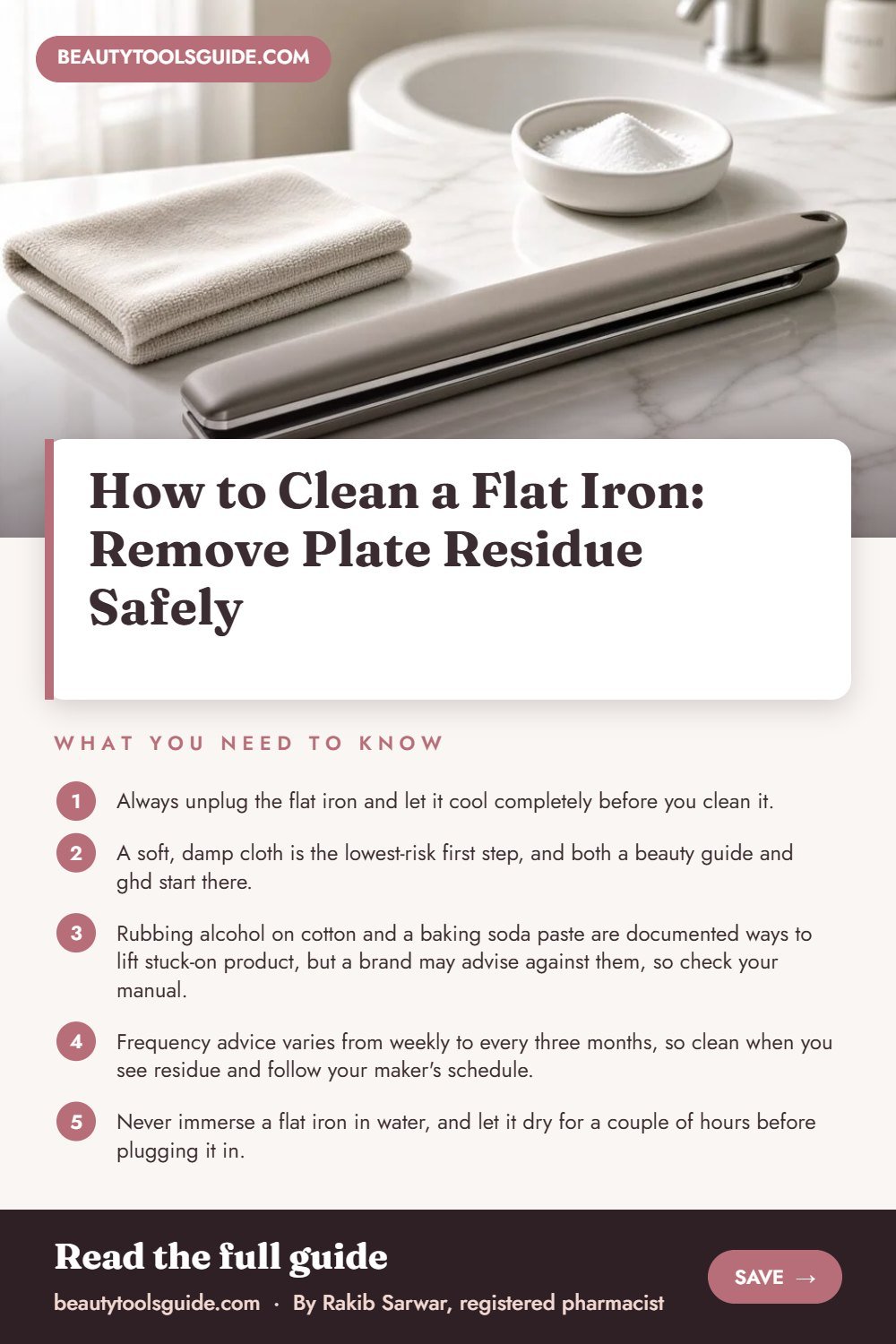
- Always unplug the flat iron and let it cool completely before you clean it.
- A soft, damp cloth is the lowest-risk first step, and both a beauty guide and ghd start there.
- Rubbing alcohol on cotton and a baking soda paste are documented ways to lift stuck-on product, but a brand may advise against them, so check your manual.
- Frequency advice varies from weekly to every three months, so clean when you see residue and follow your maker’s schedule.
- Never immerse a flat iron in water, and let it dry for a couple of hours before plugging it in.
- Abrasive pads and harsh chemicals can harm coated plates, so scrub gently and only where you need to.
Why It Pays to Clean a Flat Iron Regularly
Every pass of a hot plate across styled hair transfers a little product to the metal or ceramic. Heat then bakes that layer on. ghd describes the build-up as product residue and oils, and it advises wiping it away with a soft damp cloth.
The residue is easy to ignore, because the plates still heat. But a dirty surface touches your hair every time you use the tool. That is why a regular wipe is a better habit than a rare scrub, and why a stuck-on film is easier to remove when it is fresh.
Before you start, one fact matters more than any method. A flat iron is a hot electrical appliance. Every source we read says to unplug it first, and iFixit’s guide states plainly that a flat iron should never be plugged in while you clean it.
Quick Check: How Hard Do You Need to Clean a Flat Iron?
Look at the plates under good light and answer these questions. They tell you which level of cleaning to start with.
- What do the plates look like? Clean with a slight film (A), brown or sticky patches (B), or caked-on crust or a burnt smell (C)?
- When did you last clean it? Within the last month (A), a few months ago (B), or never (C)?
- Do you know your plate material? Yes, and the manual allows alcohol or paste (A), or no or unsure (B)?
- Is there any damage? No (A), or scratches, peeling coating, a damaged cord or a loose plate (B)?
Mostly A: unplug, cool, then wipe with a damp cloth. Stop there if the film comes off.
Any B on question 1 or 2: add a cotton ball with rubbing alcohol on the stuck-on spots.
C on question 1: use the deeper paste method, gently, after checking your manual. B on question 3: stick to the damp cloth only.
B on question 4: do not keep scrubbing. See the section on when to replace or ask the maker.
Methods to Clean a Flat Iron, Compared
Several methods circulate online, and they are not all equally gentle. The table lays out what each source says and where the risks lie.
| Method | What it is | Source and caution |
|---|---|---|
| Damp cloth | Soft cloth, lightly damp, wiped over the cooled iron | Used by ghd and PureWow; lowest-risk first step |
| Rubbing alcohol | Cotton ball dipped in rubbing alcohol, swabbed over the plates | Suggested by PureWow; ghd warns against harsh chemical cleaners, so check your manual |
| Baking soda and hydrogen peroxide paste | Thick paste on the plates, left 5 minutes, then scrubbed off | iFixit guide; abrasive paste, so use gently and check your plate material |
| Toothbrush or melamine sponge | Gentle scrubbing on tough spots and edges | PureWow; concentrate on stubborn spots only |
The pattern is clear. Start with the gentlest method and move up only when the residue stays. A harsher method is a trade-off, not an upgrade, because every step up risks the plate coating.
How to Clean a Flat Iron Step by Step
This sequence follows the safe parts of all the sources. Work through it from the gentlest step to the strongest, and stop as soon as the plates look clean.
- Unplug the iron. Disconnect it from the mains and set it on a heat-safe surface.
- Let it cool completely. ghd and PureWow both say to wait until it is fully cool.
- Wipe the whole iron. Use a soft, damp cloth on the plates and housing to remove loose residue and oils.
- Swab stuck-on spots. Dip a cotton ball in rubbing alcohol, as PureWow suggests, and rub the residue. Skip this step if your manual advises against it.
- Treat the edges. Use a clean, soft toothbrush on the lip where the plate meets the plastic, where product collects.
- Wipe again with a damp cloth. Remove any alcohol or residue so nothing bakes on next time.
- Dry fully before use. ghd says to leave the straightener for a couple of hours and not to use it until it is completely dry.
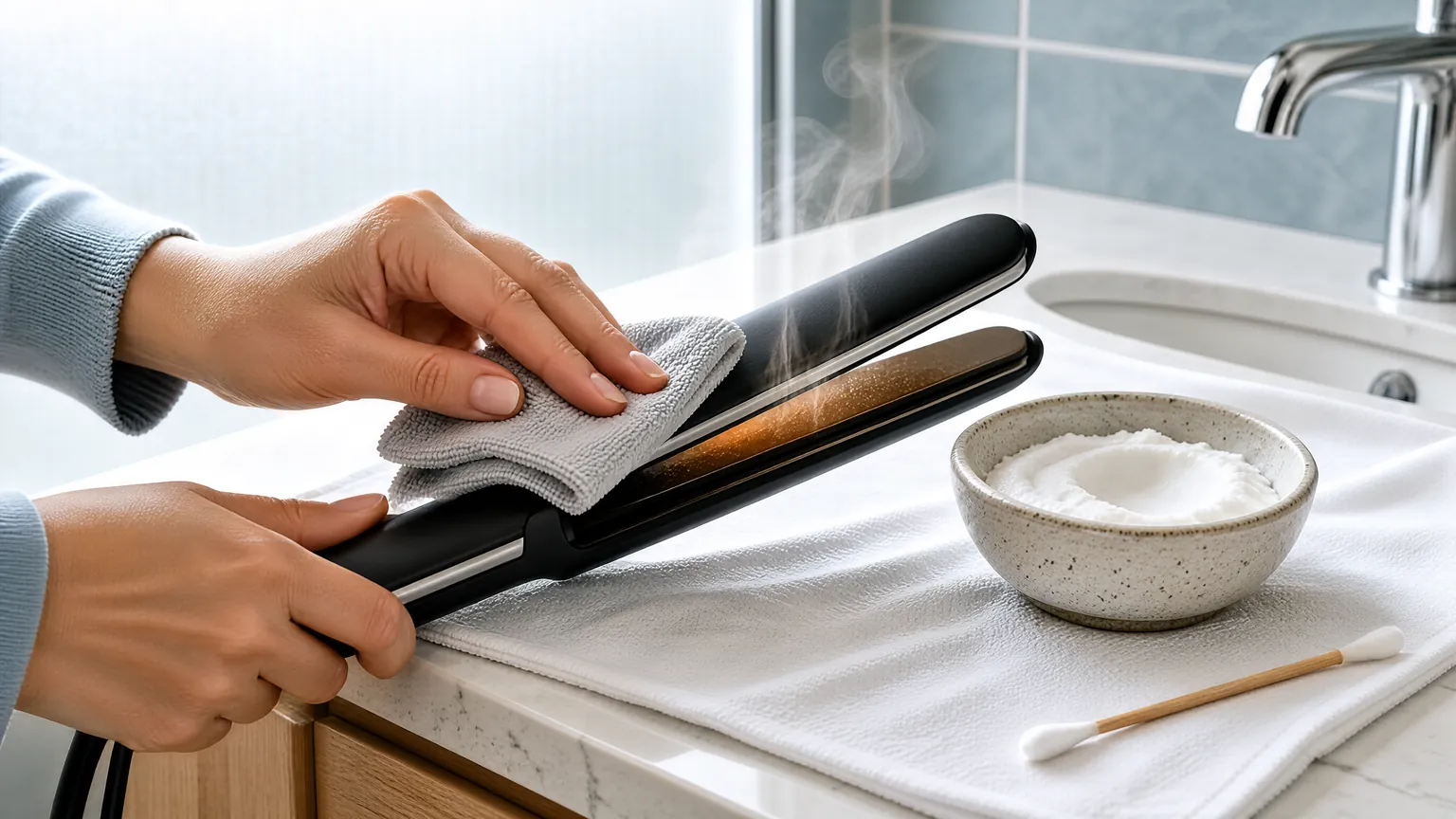
Deep Clean a Flat Iron With Baking Soda Paste
Sometimes a damp cloth and alcohol do not lift a crust. iFixit publishes a paste method for those cases. It is a stronger option, so treat it as a last step and use it with care.
- Mix one to three tablespoons of baking soda, depending on plate size, in a small bowl.
- Add about ten drops of hydrogen peroxide for each tablespoon and stir to a thick, grainy paste, similar to toothpaste.
- Spread a thick layer over the cool, unplugged plates and wait about five minutes.
- Wipe off the excess, leave a thin layer, and scrub the plates for two to five minutes until the buildup is gone.
- Wipe off the rest of the paste with a damp cloth and dry the iron fully.
Baking soda is a mild abrasive, so keep the pressure light. Use this method only where the instructions for your iron allow it, and never use it on a plate with a damaged or peeling coating. If you store your tools together after cleaning, our guide on how to organize hair styling tools can help you keep them dry and apart.
Do and Don’t When You Clean a Flat Iron
These are the rules that appear across the sources, plus the logic behind them.
- Unplug the iron first
- Wait until it is fully cool
- Start with a soft damp cloth
- Scrub gently and only where needed
- Dry it completely before use
- Read the care section of your manual
- Clean it while it is plugged in or hot
- Immerse it in water
- Use abrasive, corrosive or harsh chemical cleaners if the maker advises against them
- Use wipes that are not recommended by the maker
- Switch it on before it is dry
- Scrub a damaged coating
How Often to Clean a Flat Iron
This is where the two sources split. PureWow recommends cleaning a straightener at least once a week. ghd recommends cleaning it every three months. The difference is large, so how do you decide?
| Source | Suggested frequency | What it advises |
|---|---|---|
| PureWow | At least once a week | Rubbing alcohol on cotton, damp cloth, toothbrush for stubborn spots |
| ghd | Every three months | Soft damp cloth on the outside; no abrasive, corrosive or harsh chemical cleaners |
| iFixit | No schedule given | Baking soda and hydrogen peroxide paste for caked-on buildup |
Use the plates themselves as your guide. If you use a lot of product, style daily or see a film after a week, clean more often. If you use the iron occasionally on clean, product-free hair, a longer gap is reasonable. Whatever the schedule, wipe the iron when you see residue. Older buildup is harder to remove, and a fresh film often needs nothing more than a cloth.
Housing, Cord and Hinge
The plates are not the only parts that need attention. The outside of the iron collects oil and product from your hands and from the air, and the hinge can collect hair.
- Housing: ghd says to wipe the outside with a soft, damp cloth to remove product residue, oils and build-up.
- Cord: run a cloth along it and check for cuts or kinks as you go.
- Hinge and plate gap: use a dry toothbrush or a cotton swab to lift loose hair.
Travelling with your iron is another reason to keep it clean. Packing a dirty tool can transfer residue to everything else in your bag, and our guide to bringing hair tools on a plane covers cooling and packing rules.
Keeping Plates Clean for Longer
Prevention is simpler than scrubbing. Most buildup comes from product that cooks onto the plates, so reducing product on the hair that touches the iron helps.
- Style hair that is fully dry and as free of heavy product as you can manage.
- Apply any spray product, then give it a moment before you pass the iron through.
- Wipe the plates once the iron has cooled, before you put it away.
- Store the iron somewhere clean and dry.
These habits do not guarantee spotless plates, but they cut down the amount of residue that sticks.
Myths About How to Clean a Flat Iron
A few ideas keep circulating that the sources do not support. Here is what to do instead.
- “Heat will burn the residue off.” No source we read recommends heating the plates to clear residue. Every one says to clean the iron when it is cool and unplugged.
- “Scrubbing harder cleans better.” Hard scrubbing can scratch a coated plate. PureWow suggests concentrating the scrub on tough spots only, and ghd warns against abrasive cleaners.
- “Rinse it under the tap.” ghd says not to immerse the straightener in water. A damp cloth gives you the moisture you need.
- “A dirty iron only looks bad.” Residue sits on the surface that touches your hair on every pass, so a clean plate is worth a few minutes.
Honest Limits
Cleaning will not repair a worn tool, and it will not make an old iron safe. If the plate coating has scratched, flaked or worn through, scrubbing will not restore it. A clean iron with a damaged surface is still a damaged iron.
The sources are also limited. The methods come from a beauty publication, a hair tool brand and a repair guide, not from lab tests on specific coatings. They disagree on frequency and on chemicals, and we could not find a single standard that covers every iron. That is why the safest rule is to read the care section for your model.
Finally, no cleaning method undoes heat damage to your hair. Cleaning keeps the surface tidy, but it does not change the temperature or the number of passes you make.
When to Replace the Iron or Ask the Maker
Some problems are beyond a cloth. Stop using the iron and contact the manufacturer, or replace it, if you notice any of these.
- A frayed, cut or damaged cord
- Peeling, flaking or deeply scratched plate coating
- A burning smell that persists after cleaning
- Plates that no longer align or heat unevenly
- A housing that is cracked or loose
If the iron is under warranty, ask the maker before you try any strong method, because a manufacturer may specify what it covers.
- Topsy turvy hair tool: how to use it step by step.
Frequently Asked Questions
How do you clean a flat iron safely?
Unplug it, let it cool completely, wipe it with a soft damp cloth, and treat stuck-on spots gently. Dry it fully before you use it again.
Can you clean a flat iron with rubbing alcohol?
PureWow suggests swabbing the plates with a cotton ball dipped in rubbing alcohol. ghd advises against harsh chemical cleaners, so check your manual first.
How do you clean a flat iron with baking soda?
iFixit mixes baking soda with hydrogen peroxide to make a thick paste, leaves it on the plates for about five minutes, then scrubs it off. Use light pressure.
How often should you clean a flat iron?
Advice ranges from weekly to every three months. Clean whenever you see residue, and follow your maker’s schedule.
Can you clean a flat iron while it is hot?
No. Unplug it and let it cool completely first, because hot plates burn and moisture near a live appliance is unsafe.
Can you put a flat iron in water?
No. ghd says not to immerse a straightener in water, and to let it dry fully before it is plugged in.
What removes burnt-on hair product from flat iron plates?
Start with a damp cloth, then alcohol on cotton, then a gentle scrub on stubborn spots. A paste is the strongest option and needs care.
Will cleaning damage the plate coating?
It can if you use abrasive pads, harsh chemicals or heavy pressure. Use the gentlest method first and check your manual.
How long should I wait before using the iron again?
ghd says to let the straightener dry for a couple of hours and not to use it until it is completely dry.
When should I replace my flat iron instead of cleaning it?
Replace it if the cord is damaged, the coating is peeling or scratched, or it smells of burning after cleaning.
The Bottom Line
You can clean a flat iron in a few minutes with an unplugged, fully cool iron and a damp cloth. Add rubbing alcohol or a baking soda paste only for stubborn residue, and check your manual before you use either.
Dry the iron completely, wipe it lightly after use, and replace it if the cord or the coating is damaged. A clean iron will not fix a worn one, but it keeps a good one working as it should.